
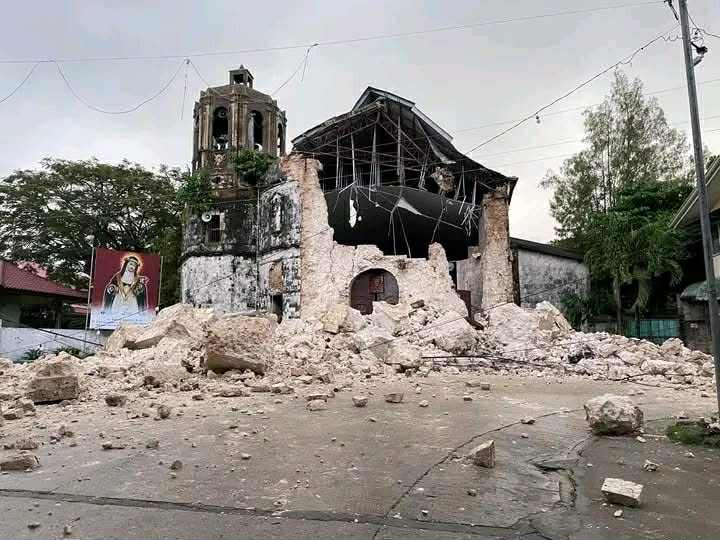
Centuries-old churches that once anchored faith and history in northern Cebu now sit scarred, walls split, pediments fallen, after the magnitude-6.9 earthquake on Sept. 30.
To jump-start recovery, the Cebu Provincial Board has appealed to the Tourism Infrastructure and Enterprise Zone Authority (Tieza) for funding support to restore and reconstruct damaged heritage churches.
The request, filed by 7th District Board Member Paz Rozgoni, was approved at the board’s regular session on Monday, Oct. 20.
The resolution said the churches are not only centers of worship but “vital cultural landmarks that drive local tourism,” adding that prompt repairs would hasten the province’s economic recovery.
“The faster these churches or structures are restored, repaired, reconstructed, and developed, the faster the tourism industry of the Province of Cebu can recover,” it read.
Among the affected are the Sts. Peter and Paul Parish (Bantayan), Capelinha de Fátima replica (San Remigio), St. Ignatius de Loyola Parish (Kawit, Medellin), San Nicolas de Tolentino Parish (Malabuyoc), and Our Lady of Odlót Parish (Bogo City).
Several sustained major structural cracks; others partially collapsed.
The Bantayan church, one of Cebu’s oldest landmarks, was among the hardest hit, with its pediment and cross partially collapsing.
Authorities have cordoned off the site and declared it unsafe. Parishioners now hear Mass outdoors under temporary setups, bringing their own chairs and umbrellas.
Reports that devotees took bits of fallen debris as anting-anting prompted parish team moderator Fr. Edmar Marcellones to call the act theft and a violation of sacred heritage.
“Every fragment of stone and material is part of our sacred heritage and must be preserved,” he said, urging the faithful to leave restoration to experts.
Parroquia de San Pedro Apóstol (Bantayan) is the first northern Cebu heritage site to undergo a Rapid Assessment and Evaluation by the National Historical Commission of the Philippines, in coordination with the National Commission for Culture and the Arts, the International Council on Monuments and Sites, the University of San Carlos Conservation and Heritage Research Institute, and the Cebu Archdiocesan Commission for the Cultural Heritage of the Church.
Marcellones described it as the start of a “long, technical, and scientific process” toward full restoration. An Earthquake Repair Project is being organized, with a dedicated bank account set up for transparent fund management.
According to the Cebu Provincial Disaster Risk Reduction and Management Office, the quake affected 203,400 families (645,570 individuals) across northern Cebu.
The Department of the Interior and Local Government confirmed 79 deaths and 1,325 injuries. Infrastructure losses were severe, with 129,170 houses partially damaged and 4,596 destroyed; government offices, schools, health centers, and churches in San Remigio, Tabogon, and Borbon also suffered extensive damage.
Cebu Business News
Leave a Reply